
Choosing delivery bags is one of the biggest equipment decisions a home-delivered meal program makes. The right bags keep every meal at a safe temperature, last for years and are easy for volunteers to carry. The wrong ones cost more in replacements, complaints and cold meals. Here’s what to look for.
In this guide 9 sections
1. Tray capacity, measured honestly
Bag listings usually say how many trays a bag holds, but tray sizes vary. Before you compare, check which tray the count is based on. Our counts use the industry-standard Meals on Wheels 3-compartment tray with standard lid, about 8½” × 6½” × 1½” high. Deep trays and raised lids take more room, so a bag holds fewer of them.
Also check whether the count assumes an insulated pad or divider is in place. Our blue non-electric bags come with an optional insulated pad, and we list capacity both with and without it.
2. How the bag keeps meals hot
A plain insulated bag only slows heat loss. Every time a driver opens it, the meals inside cool off. For routes longer than about 30 minutes, or in cold weather, you need a heat source:
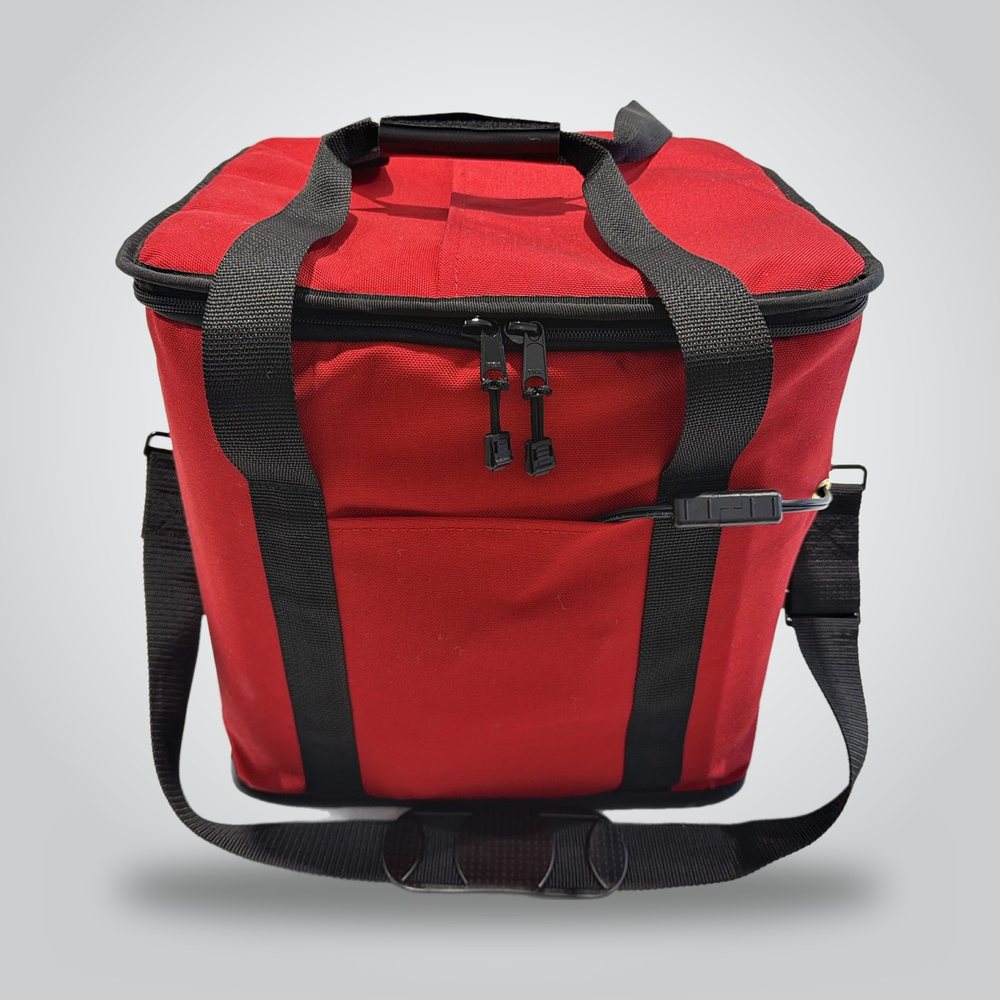
- Electric thermal bags have a heater built into the bag that plugs into the vehicle’s 12-volt outlet. They hold meals above 140°F with the bag zipped and add heat back as meals are removed. Plug them in about 30 minutes before loading.
- An Electric Bag Heater is a separate heating panel that turns a non-electric bag into a heated one. It heats up in minutes.
- RouteHeat™ heat units are reusable heat packs that keep meals hot for up to four hours, with no power needed.
See Electric vs. Non-Electric Thermal Bags for which fits your routes.
3. Materials that survive daily use
Delivery bags get carried, dropped, loaded and wiped down every day. Look for:
- A heavy, water-resistant outer shell (ours is 1000-denier vinyl-coated nylon)
- A zip-out liner with sealed seams, so spills don’t soak into the insulation and the liner can be replaced when it wears
- Straps sewn down to the bottom of the bag, not just to the sides
- A firm bottom tray or frame so the bag stands upright and loads easily
4. Weight and ease of carrying
Many drivers are older volunteers. A loaded bag needs to be comfortable to lift in and out of a car many times a day. Compare empty weights, and check for both handles and an adjustable shoulder strap. Two smaller bags are often easier to manage than one very large one.
5. Easy cleaning
Health inspectors and your own staff will expect bags to be cleaned regularly. A wipe-clean liner that zips out takes minutes. Bags that can’t be cleaned inside tend to be replaced early.
6. Warranty, repairs and replacement parts
Ask what happens when a zipper, cord or liner wears out. Can you buy the part, or do you have to replace the whole bag? Our bags come with a 1-year limited warranty, and we sell replacement liners, cords, bottom trays and pads. We also repair bags.
7. Who makes it
Bags made for home-delivered meals are sized for meal trays and built for routes. Ours have been designed and hand-sewn in Malden, Massachusetts, since 1977, for senior nutrition programs only.
Quick checklist
- Tray count based on a standard tray, with and without any pad
- A heat source suited to your route length and climate
- Heavy shell, zip-out liner, reinforced straps
- Comfortable for volunteers to carry
- Replacement parts, repairs and a clear warranty
Need help choosing?
Use our free Route Planner, read How Many Thermal Bags Does a Program Need?, or call 1-800-332-6566 and we’ll recommend bags for your routes.
Products in this guide
Most popular with Meals on Wheels programs
- Thermal bags: electric and non-electric, hand-sewn in the USA since 1977
- REusable meal trays: about 4¢ a meal vs. 29¢ to 56¢ for disposables (free samples)
- Electric Bag Heater: patented heater that makes any thermal bag electric
- RouteHeat™ heat units: reusable, 140°F to 160°F for 3 to 4 hours, no outlet needed